
Jordan has six land border crossings with five neighboring countries. Five of these crossings issue visas on arrival to eligible nationalities. The one major exception is the Allenby/King Hussein Bridge, which connects to the West Bank and does not issue visas on arrival under any circumstances.
This guide covers every Jordan land border crossing where you can obtain a visa on arrival, what to expect at each one, and how to prepare for a smooth entry.
Jordan Land Border Crossings Overview
Jordan shares land borders with Saudi Arabia, Iraq, Syria, Israel, and the West Bank. Each border has at least one official crossing point. Here is a complete list of Jordan’s land border crossings and their visa on arrival status:
| Border Crossing | Border With | VoA Available | Best For |
|---|---|---|---|
| Al-Haditha / Omari | Saudi Arabia | Yes | Travelers from Saudi Arabia, Gulf states |
| Jaber / Nassib | Syria | Yes | Travelers from Syria, Lebanon (overland) |
| Al-Karamah / Trebil | Iraq | Yes | Travelers from Iraq |
| King Hussein / Allenby Bridge | West Bank | **No** | Those with pre-arranged visa only |
| Jordan River / Sheikh Hussein | Israel | Yes | Northern Israel travelers |
| Wadi Araba / Yitzhak Rabin | Israel (Aqaba) | Yes | Southern Israel, Eilat travelers |
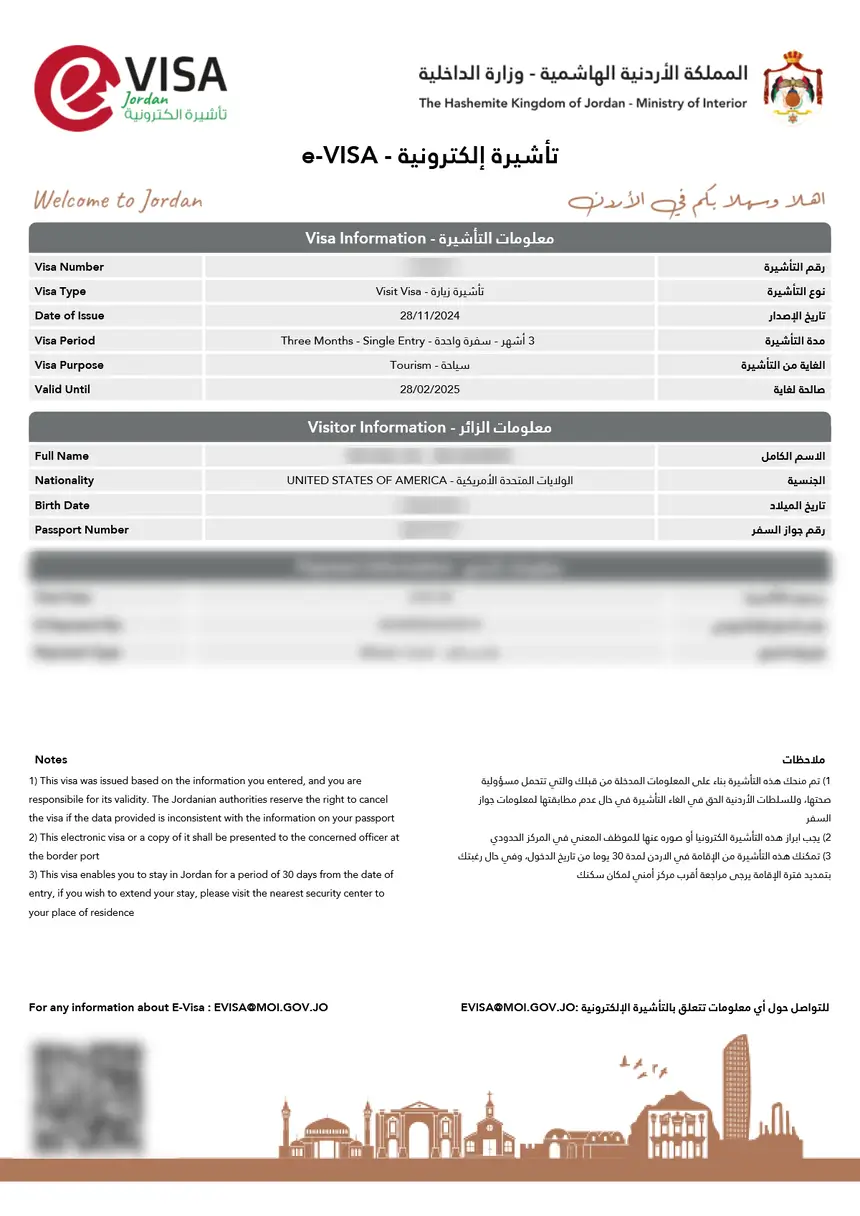
If you are entering Jordan by land and need a visa on arrival, any crossing except Allenby Bridge will work. For Allenby Bridge, you must obtain a Jordan eVisa or a Jordan Pass before crossing.
Al-Haditha / Omari Border Crossing (Saudi Arabia)
The Al-Haditha crossing on the Jordanian side (called Omari on the Saudi side) is the main land border between Jordan and Saudi Arabia. It is located in southern Jordan, roughly 330 km from Amman and about 160 km from Aqaba.
Key facts:
– Visa on arrival is available for eligible nationalities
– Open 24 hours a day, 7 days a week (subject to change – verify before travel)
– The most heavily used land crossing into Jordan
– Bus services connect Amman to Riyadh and other Saudi cities via this crossing
– JOD and USD cash accepted for visa payment
What to expect: The crossing has separate sections for private vehicles, buses, and freight. After arriving at the Jordanian side, proceed to the immigration hall. If you need a visa on arrival, look for the visa counter before the passport control booths. Pay the fee, receive your stamp, and proceed through immigration. Processing time is typically 15-45 minutes, but can be longer during peak periods (especially Hajj season and Eid holidays).
Transport onward: Shared taxis and buses run from the border to Amman (approximately 4-5 hours) and Aqaba (approximately 2 hours). Private taxis are also available but more expensive.
Jaber / Nassib Border Crossing (Syria)
The Jaber crossing on the Jordanian side (called Nassib on the Syrian side) is the primary land border between Jordan and Syria. It is located in northern Jordan, about 80 km from Amman.
Key facts:
– Reopened in October 2018 after being closed for three years due to the Syrian conflict
– Visa on arrival is available for eligible nationalities
– Open from approximately 6:00 AM to 10:00 PM (hours may vary – verify before travel)
– Located on the Amman-Damascus highway
– Also used by travelers transiting between Jordan and Lebanon overland
What to expect: The crossing was renovated after reopening and has modern facilities. Proceed to the immigration hall on the Jordanian side, pay your visa fee at the counter if needed, and go through passport control. The crossing can be busy, particularly on weekends and holidays.
Important note: Check current security conditions before planning overland travel through Syria. The Syrian side of the crossing is under Syrian government control, but conditions in other parts of Syria may affect travel safety. Travelers should consult their government’s travel advisories before using this route.
Al-Karamah / Trebil Border Crossing (Iraq)
The Al-Karamah crossing on the Jordanian side (called Trebil on the Iraqi side) is the sole land border crossing between Jordan and Iraq. It is located in eastern Jordan, approximately 330 km east of Amman.
Key facts:
– Visa on arrival is available for eligible nationalities
– Iraqi citizens with a valid Schengen, UK, or US visa can also obtain visa on arrival
– Open 24 hours a day, 7 days a week (subject to change)
– Located in a remote desert area – limited services nearby
– The crossing is on the main Baghdad-Amman highway
What to expect: The crossing is straightforward but can have long wait times, particularly for freight traffic. The Jordanian side has a modern immigration facility. If you need a visa on arrival, proceed to the visa counter, pay the fee, and go through passport control.
Special rule for Iraqi citizens: Iraqi passport holders who do not have a valid Schengen, UK, or US visa cannot obtain a visa on arrival at this (or any) crossing. They must apply for a visa in advance through the Jordan Ministry of Interior e-services portal.
Transport onward: Shared taxis run between the border and Amman. The journey takes approximately 4-5 hours. There are also bus services connecting to Baghdad, though schedules vary. Fuel and rest stops are limited along the desert highway.
King Hussein / Allenby Bridge (No Visa on Arrival)
The King Hussein Bridge, also known as the Allenby Bridge, is the main crossing between Jordan and the West Bank. It is located about 57 km west of Amman, in the Jordan Valley.
This crossing does NOT issue visas on arrival. This is the single most important exception to Jordan’s visa on arrival policy. Every traveler – regardless of nationality – must have a valid Jordanian visa, eVisa, or Jordan Pass before arriving at this crossing.
Key facts:
– No visa on arrival under any circumstances
– Israeli citizens are not permitted to use this crossing
– The crossing is operated jointly by Jordanian, Palestinian, and Israeli authorities
– Passport stamps are generally not placed in passports at this crossing
– Open Sunday through Thursday, approximately 8:00 AM to 2:00 PM (hours vary – verify before travel)
– Closed on Fridays, Saturdays, and some holidays
How to get a visa for Allenby Bridge: Apply for a Jordan eVisa online at least 10 business days before your trip, or purchase a Jordan Pass which includes the visa fee waiver. If you already have a valid Jordanian visa from a previous entry (for double or multiple-entry visas), you can also use that.
What to expect: The crossing process involves three stages: exit from the West Bank/Palestinian Authority side, Israeli checkpoint, and entry into Jordan. The process can take 1-3 hours depending on traffic. Buses and shared taxis connect the crossing to Amman and Jericho.
Why no visa on arrival here? The Allenby Bridge crossing is technically not an international border crossing in the traditional sense. It operates under a special arrangement related to the Israeli-Palestinian peace process. Jordan treats it differently from its other border crossings, which is why visa on arrival is not available.
Jordan River / Sheikh Hussein Border Crossing (Israel)
The Jordan River crossing, also called the Sheikh Hussein Bridge crossing, is located in northern Jordan near the city of Irbid. It connects to northern Israel.
Key facts:
– Visa on arrival is available for eligible nationalities
– Open Sunday through Saturday, approximately 6:30 AM to 10:00 PM (hours vary – verify before travel)
– Less crowded than the Allenby Bridge crossing
– Located about 90 km north of Amman
– A convenient crossing for travelers visiting the Sea of Galilee, Nazareth, or northern Jordan
What to expect: The process is relatively quick compared to other crossings. On the Jordanian side, proceed to the immigration hall, obtain your visa on arrival if needed, and go through passport control. Most travelers complete the process in 20-40 minutes.
Transport onward: Shared taxis and buses connect the crossing to Irbid (about 15 km) and Amman (about 90 km). On the Israeli side, buses run to Beit She’an and connect to the wider Israeli transport network.
Wadi Araba / Yitzhak Rabin Border Crossing (Israel – Aqaba)
The Wadi Araba crossing (called Yitzhak Rabin on the Israeli side) connects southern Jordan near Aqaba with Eilat in southern Israel. It is the southernmost crossing between the two countries.
Key facts:
– Visa on arrival is available for eligible nationalities
– Open Sunday through Saturday, approximately 6:30 AM to 8:00 PM (hours vary – verify before travel)
– Located just north of Aqaba and Eilat
– Popular with travelers visiting Aqaba, the Red Sea, or connecting to Petra
– Free zone area on both sides
What to expect: This is one of the quickest and least congested land crossings into Jordan. The immigration process on the Jordanian side typically takes 15-30 minutes. The crossing is within walking distance of both Aqaba (Jordan) and Eilat (Israel), though taxis are available.
Transport onward: Aqaba city center is about 10 km from the crossing. Taxis and local buses are available. From Aqaba, you can reach Petra (about 2 hours by car) or Wadi Rum (about 1 hour by car).
Visa on Arrival Fees at Land Border Crossings
The visa on arrival fee at all Jordan land border crossings is the same as at the airport:
| Visa Type | Fee (JOD) | Fee (USD approx.) | Stay Duration |
|---|---|---|---|
| Single entry | 40 JOD | $56 USD | Up to 30 days |
| Double entry | 60 JOD | $85 USD | 30 days per entry |
| Multiple entry | 120 JOD | $170 USD | 3-6 months |
Payment tips for land borders:
– Cash is strongly recommended. Credit card acceptance is inconsistent at land crossings. Some terminals may be offline.
– JOD or USD accepted. US dollars are widely accepted, though change may be given in JOD.
– Bring exact or small bills. Some crossings may not have change for large denomination notes.
– ATMs are unreliable. Not all border crossings have ATMs, and those that do may not work with foreign cards. Withdraw cash before arriving.
Money-saving option: If you plan to stay 3 or more consecutive nights in Jordan, the Jordan Pass (70-80 JOD) waives the visa fee and includes entry to 40+ attractions including Petra. It is a better deal than paying the visa fee separately.
Documents Needed for Visa on Arrival at Land Borders
Prepare these documents before arriving at any Jordan land border crossing:
- Valid passport with at least 6 months of remaining validity from your date of entry
- 1-2 blank pages in your passport for stamps
- Visa fee in cash (JOD or USD) – 40 JOD for single entry
- Return or onward ticket (sometimes requested but not always enforced)
- Proof of accommodation – hotel booking confirmation or host address in Jordan
- Jordan Pass (if applicable) – present at the visa counter to waive the fee
Processing time at land borders varies from 15 to 60 minutes depending on the crossing, time of day, and number of travelers. Weekend mornings and holiday periods tend to be the busiest.
Countries Eligible for Visa on Arrival at Land Borders
Citizens of over 50 countries can obtain a visa on arrival at Jordan land borders. However, many nationalities have conditional eligibility – meaning you can only get a visa on arrival if you hold a valid residence permit from the EU, GCC, US, UK, Canada, Australia, or similar countries.
Unconditional visa on arrival: Citizens of most Western and developed countries (US, UK, Canada, Australia, EU member states, Japan, South Korea, etc.) can obtain a visa on arrival at any land border without conditions.
Conditional visa on arrival: Citizens of many African and Asian countries (such as Nigeria, Pakistan, India, Philippines, Ethiopia, etc.) can obtain visa on arrival only if they hold a valid residence permit (6+ months validity) from the EU, GCC, US (Green Card), UK, Canada, Australia, Iceland, Liechtenstein, Norway, or Switzerland. Without such a permit, they must apply for a visa in advance.
No visa on arrival (must apply in advance): Citizens of Afghanistan and Syria cannot obtain visa on arrival under any conditions and must apply through the Jordan Ministry of Interior portal.
For the full list of eligible nationalities and conditions, see our Jordan visa on arrival guide.
Tips for Crossing Jordan’s Land Borders
1. Arrive early. Border crossings can have unpredictable queues. Arriving early in the day gives you the best chance of a quick process and time to reach your destination before dark.
2. Carry cash. USD and JOD are both accepted at all crossings. Do not rely on credit cards or ATMs at the border.
3. Check crossing hours. Not all crossings are open 24 hours. Allenby Bridge has the most limited hours (closed Fridays, Saturdays, and holidays). Verify current hours before traveling.
4. Bring copies of your documents. Have photocopies or digital copies of your passport, hotel bookings, and onward travel tickets. Some immigration officers may request them.
5. Be patient and polite. Land border procedures can be slower than airport immigration. Officers may ask additional questions about your travel plans. Answer honestly and calmly.
6. Consider the Jordan Pass. If staying 3+ nights, the Jordan Pass saves money and simplifies the visa process at any land crossing.
7. Check travel advisories. Some border crossings (particularly Jaber/Nassib with Syria and Al-Karamah/Trebil with Iraq) may have security advisories. Check your government’s travel guidance before crossing.
8. Arrange onward transport in advance. Not all crossings have reliable public transport. Pre-arrange a taxi or have a plan for reaching your next destination.
Frequently Asked Questions
Can I get a visa on arrival at every Jordan land border?
No. Five of the six land border crossings issue visas on arrival. The Allenby/King Hussein Bridge crossing to the West Bank does not issue visas on arrival. You must have a valid visa, eVisa, or Jordan Pass before crossing at Allenby Bridge.
Which Jordan land border crossing is the busiest?
The Al-Haditha/Omari crossing with Saudi Arabia is the busiest land border, handling the most traffic including buses, private vehicles, and freight. The Jaber/Nassib crossing with Syria is also busy since its 2018 reopening. For a quicker crossing, the Wadi Araba/Yitzhak Rabin crossing near Aqaba is typically the least congested.
Can I pay by credit card at Jordan land borders?
Credit card acceptance is unreliable at Jordan land borders. While the Queen Alia International Airport accepts credit cards consistently, land crossings may have offline terminals or no card facilities at all. Always carry sufficient cash in JOD or USD to cover the visa fee.
What are the hours for Jordan land border crossings?
Hours vary by crossing. Al-Haditha (Saudi border) and Al-Karamah (Iraq border) are generally open 24 hours. Jaber (Syria border) operates roughly 6 AM to 10 PM. Sheikh Hussein and Wadi Araba (Israel borders) operate roughly 6:30 AM to 8-10 PM. Allenby Bridge is open Sunday-Thursday only, approximately 8 AM to 2 PM. Always verify current hours before traveling as they can change.
Do I need a visa in advance for the Allenby Bridge?
Yes. The Allenby/King Hussein Bridge does not issue visas on arrival. You must have a valid Jordanian visa, eVisa, or Jordan Pass before arriving. Apply for an [eVisa online](https://evisa-jordan.info/jordan-evisa/) at least 10 business days before your trip.
Can Iraqi citizens get a visa on arrival at Jordan land borders?
Iraqi citizens can get a visa on arrival at Jordan land borders only if they hold a valid Schengen area visa, UK visa, or US visa. Without one of these, Iraqi citizens must apply for a visa in advance through the Jordan Ministry of Interior portal.
How long does it take to cross a Jordan land border?
Processing time ranges from 15 to 60 minutes depending on the crossing, time of day, and volume of travelers. The Wadi Araba crossing near Aqaba is typically the fastest (15-30 minutes), while Allenby Bridge can take 1-3 hours due to its multi-stage process involving three authorities.
Can I use a Jordan Pass at land border crossings?
Yes. The Jordan Pass can be presented at the visa counter at any land border crossing that issues visas on arrival. The visa fee is waived if you have a Jordan Pass and plan to stay at least 3 consecutive nights in Jordan. Show the Jordan Pass (on your phone or printed) to the immigration officer.