
Jordan’s visa policy determines who can enter the country, how long they can stay, and what documents they need. Whether you are from a visa-free nation, eligible for an eVisa, or must apply through an embassy, understanding Jordan’s entry rules before you travel will save you time and avoid problems at the border. This guide covers every aspect of Jordan’s visa policy – from exemptions and eVisa access to special rules at specific border crossings.
What Is Jordan’s Visa Policy?
Jordan maintains a tiered visa system that categorizes foreign nationals into three main groups:
- Visa-free travelers – Citizens of select countries who can enter with just a valid passport
- eVisa and visa-on-arrival travelers – Nationals of over 120 countries who can apply online or get a visa at the airport
- Embassy visa travelers – Citizens of restricted countries who must apply through a Jordanian diplomatic mission
The policy is managed by the Jordanian Ministry of Interior (MOI) and enforced at all ports of entry including Queen Alia International Airport, land border crossings, and the Aqaba port. The official eVisa portal at eservices.moi.gov.jo handles all electronic applications.
Jordan’s visa policy is designed to balance security with tourism revenue. The country welcomes over 6 million visitors per year, and the visa framework reflects Jordan’s goal of making entry straightforward for most nationalities while maintaining controls on a small number of restricted countries.
Visa-Free Countries
Jordan grants visa-free entry to citizens of a select group of countries, primarily fellow Arab and regional nations. If you hold a passport from one of these countries, you do not need to apply for any visa in advance and can enter Jordan with just a valid passport.
| Country | Region | Maximum Stay |
|---|---|---|
| Bahrain | Gulf (GCC) | 90 days |
| Kuwait | Gulf (GCC) | 90 days |
| Oman | Gulf (GCC) | 90 days |
| Qatar | Gulf (GCC) | 90 days |
| Saudi Arabia | Gulf (GCC) | 90 days |
| United Arab Emirates | Gulf (GCC) | 90 days |
| Lebanon | Middle East | 90 days |
| Turkey | Middle East/Europe | 90 days |
| Libya | North Africa | 90 days |
| Syria | Middle East | 90 days |
| Yemen | Middle East | 90 days |
| Egypt | North Africa | 30 days |
GCC nationals enjoy the most straightforward entry process. They only need a passport valid for at least 6 months and can stay for up to 90 days without registering or paying any fees. Egyptian citizens also benefit from simplified entry but face a 30-day limit depending on the border crossing and purpose of visit.
If you hold dual nationality and one of your citizenships is from a visa-free country, you can use that passport to enter Jordan without arranging any visa in advance. However, you must enter and exit on the same passport.
eVisa Eligible Countries
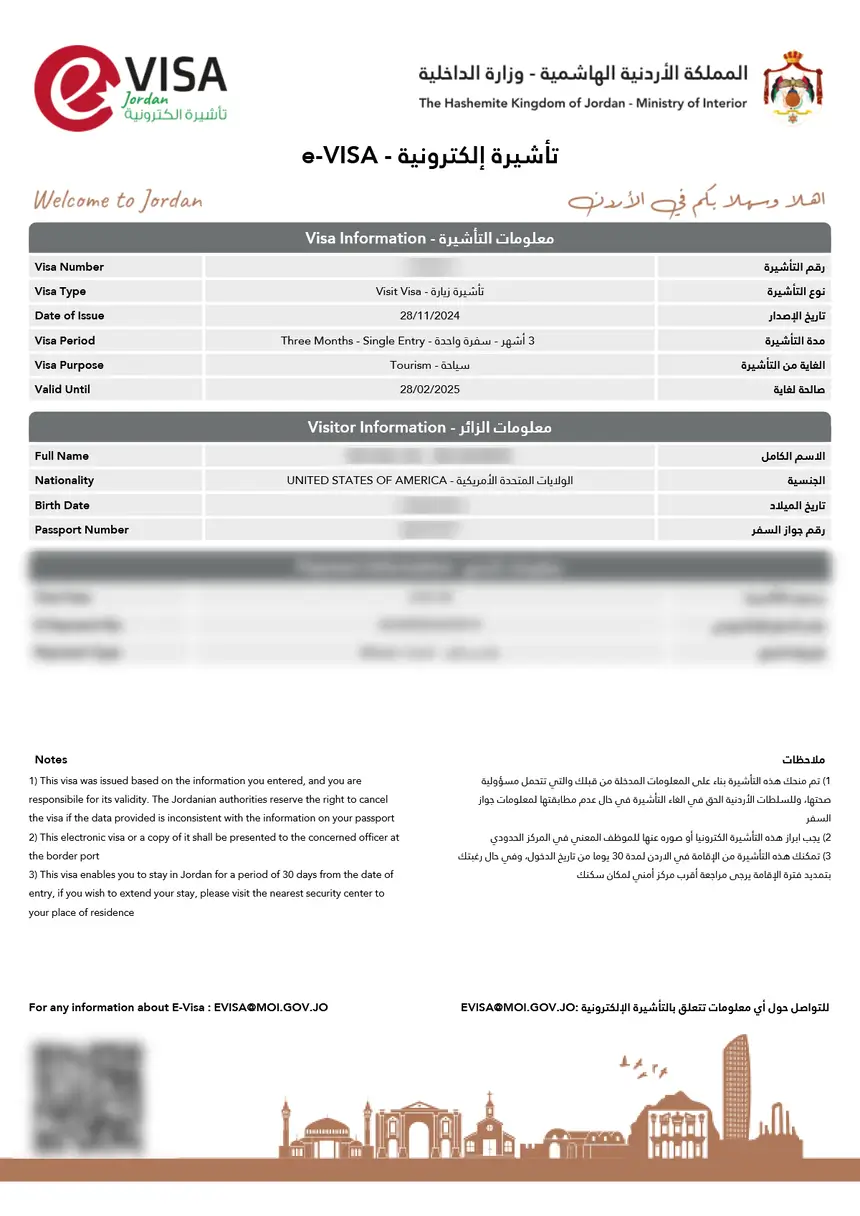
The Jordan eVisa is available to citizens of over 120 countries worldwide. The eVisa lets you apply online at eservices.moi.gov.jo before traveling, so you arrive with approval already in hand. This is the most common way for international visitors to secure Jordan entry permission.
Europe
| Country | eVisa | On Arrival |
|---|---|---|
| Albania | Yes | Yes |
| Andorra | Yes | Yes |
| Austria | Yes | Yes |
| Belarus | Yes | Yes |
| Belgium | Yes | Yes |
| Bosnia and Herzegovina | Yes | Yes |
| Bulgaria | Yes | Yes |
| Croatia | Yes | Yes |
| Cyprus | Yes | Yes |
| Czech Republic | Yes | Yes |
| Denmark | Yes | Yes |
| Estonia | Yes | Yes |
| Finland | Yes | Yes |
| France | Yes | Yes |
| Germany | Yes | Yes |
| Greece | Yes | Yes |
| Hungary | Yes | Yes |
| Iceland | Yes | Yes |
| Ireland | Yes | Yes |
| Italy | Yes | Yes |
| Kosovo | Yes | Yes |
| Latvia | Yes | Yes |
| Liechtenstein | Yes | Yes |
| Lithuania | Yes | Yes |
| Luxembourg | Yes | Yes |
| Malta | Yes | Yes |
| Moldova | Yes | Yes |
| Monaco | Yes | Yes |
| Montenegro | Yes | Yes |
| Netherlands | Yes | Yes |
| North Macedonia | Yes | Yes |
| Norway | Yes | Yes |
| Poland | Yes | Yes |
| Portugal | Yes | Yes |
| Romania | Yes | Yes |
| Russia | Yes | Yes |
| San Marino | Yes | Yes |
| Serbia | Yes | Yes |
| Slovakia | Yes | Yes |
| Slovenia | Yes | Yes |
| Spain | Yes | Yes |
| Sweden | Yes | Yes |
| Switzerland | Yes | Yes |
| Ukraine | Yes | Yes |
| United Kingdom | Yes | Yes |
All EU and Schengen area citizens are eligible for both the Jordan eVisa and visa on arrival. The eVisa is faster at the airport since you skip the visa counter queue entirely.
Americas
| Country | eVisa | On Arrival |
|---|---|---|
| Argentina | Yes | Yes |
| Brazil | Yes | Yes |
| Canada | Yes | Yes |
| Chile | Yes | Yes |
| Colombia | Yes | Yes |
| Mexico | Yes | Yes |
| Panama | Yes | Yes |
| Peru | Yes | Yes |
| United States | Yes | Yes |
| Uruguay | Yes | Yes |
US and Canadian citizens are the largest group of Western visitors to Jordan. Both can apply for the eVisa online or simply pay for a visa on arrival at the airport. The eVisa is recommended to avoid lines.
Asia-Pacific
| Country | eVisa | On Arrival |
|---|---|---|
| Australia | Yes | Yes |
| Bangladesh | Yes | Yes |
| Brunei | Yes | Yes |
| China | Yes | Yes |
| Hong Kong | Yes | Yes |
| India | Yes | Yes |
| Indonesia | Yes | Yes |
| Japan | Yes | Yes |
| Malaysia | Yes | Yes |
| Maldives | Yes | Yes |
| Nepal | Yes | Yes |
| New Zealand | Yes | Yes |
| Pakistan | Yes | Yes |
| Philippines | Yes | Yes |
| Singapore | Yes | Yes |
| South Korea | Yes | Yes |
| Sri Lanka | Yes | Yes |
| Taiwan | Yes | Yes |
| Thailand | Yes | Yes |
Indian and Pakistani citizens represent a large portion of Jordan eVisa applicants. Both are fully eligible for the eVisa and visa on arrival. The visa requirements are the same regardless of nationality, though individual consular processing may involve additional checks.
Middle East and Africa (Non-Visa-Free)
| Country | eVisa | On Arrival |
|---|---|---|
| Algeria | Yes | Yes |
| Djibouti | Yes | Yes |
| Iran | Embassy only | Embassy only |
| Iraq | Yes | Yes |
| Israel | Yes | Yes |
| Mauritania | Yes | Yes |
| Morocco | Yes | Yes |
| Palestine | Yes | Yes |
| Somalia | Embassy only | Embassy only |
| South Africa | Yes | Yes |
| South Sudan | Embassy only | Embassy only |
| Sudan | Yes | Yes |
| Tunisia | Yes | Yes |
A small number of nationalities in the Middle East and Africa are not eligible for the eVisa and must apply through a Jordanian embassy or consulate. This includes citizens of Somalia, South Sudan, and Iran.
Visa on Arrival Policy
Jordan offers visa on arrival at Queen Alia International Airport (QAIA) in Amman and at most land border crossings. If your nationality is eligible for the eVisa, you are almost always also eligible for visa on arrival. This means you can buy the visa at the border without applying online in advance.
The key exceptions are:
- King Hussein (Allenby) Bridge – Does NOT offer visa on arrival. You must have your eVisa or embassy visa pre-approved before crossing.
- Certain nationalities with restricted access – A few countries may be restricted from on-arrival processing at land borders while still being able to get one at QAIA.
Visa on arrival costs the same as the eVisa: 40 JOD (~$56) for single entry, 60 JOD (~$85) for double entry, and 120 JOD (~$170) for multiple entry. Payment is accepted in Jordanian Dinars or by credit card.
Countries Requiring Embassy Visa
Jordan restricts eVisa access for citizens of approximately 10 countries. If your nationality is not listed on the official portal at eservices.moi.gov.jo, you must apply through a Jordanian embassy or consulate in your home country or a third country.
Nationals who typically need to apply through an embassy include:
- Certain African countries facing security or diplomatic restrictions
- Select Asian countries with limited bilateral agreements
- Citizens of countries with active conflict zones
If your country is not listed on the eVisa portal, contact the nearest Jordanian embassy or consulate. The application process usually requires an invitation letter, proof of accommodation, round-trip flight booking, and bank statements. Processing times are longer than the eVisa, typically 2 to 4 weeks.
Jordan Pass and Visa Waiver
The Jordan Pass (jordanpass.jo) is a combined sightseeing and visa package that costs 70 JOD (~$99) for the Jordan Wanderer (1-day Petra) or 80 JOD (~$113) for the Jordan Explorer (2-day Petra) and the Jordan Expert (3-day Petra). It waives the visa fee entirely for eligible nationalities and includes entry to 40+ tourist attractions including Petra, Jerash, Wadi Rum, and Amman Citadel.
To qualify for the Jordan Pass visa fee waiver:
- Your nationality must be eligible for a Jordan visa (eVisa or visa on arrival)
- You must purchase the Jordan Pass before arriving in Jordan
- You must stay at least 3 consecutive nights in Jordan
The Jordan Pass saves you up to 66 JOD compared to buying the visa and Petra entry separately. It is the most cost-effective way for tourists to enter Jordan.
How to Check Your Visa Status
The easiest way to verify whether your nationality qualifies for the Jordan eVisa is to visit the official Ministry of Interior portal:
- Go to eservices.moi.gov.jo
- Click Create New Account
- During registration, the country dropdown shows all eligible nationalities
- If your country appears, you are eligible for the eVisa
You can also check by visiting the portal’s FAQ section, which lists eligible nationalities. If in doubt, contact the Jordanian embassy nearest to you for confirmation.
Key Policy Rules
Allenby Bridge Exception
The King Hussein (Allenby) Bridge crossing between Jordan and the West Bank is the only major Jordan border that does NOT offer visa on arrival. If you plan to cross here, you must have your eVisa approved in advance or hold an embassy-issued visa. This catches many travelers by surprise, especially those crossing from Israel.
Passport Validity
Regardless of your nationality or visa type, your passport must be valid for at least 6 months beyond your intended entry date into Jordan. You also need at least 1 to 2 blank pages for entry and exit stamps. Border agents will turn you away if your passport does not meet these requirements.
Overstay Penalties
Overstaying your visa in Jordan is taken seriously. Penalties include:
- Fines of 1.5 JOD per day of overstay
- Possible detention and deportation
- A ban on re-entry for a period determined by the authorities
If you realize you have overstayed, visit the nearest police station or immigration office to regularize your status before attempting to leave the country. Jordanian immigration at airports will catch overstays during exit processing.
Registration Requirements
Visitors staying in Jordan for more than 30 days are generally expected to register with the local police station or the nearest immigration office. Hotels handle this automatically for shorter stays. If you are staying with friends, in a rental, or camping, you may need to register yourself.
FAQs About Jordan Visa Policy
Is Jordan visa free for any country?
Yes. Citizens of 12 countries can enter Jordan without any visa. These are primarily GCC states (Bahrain, Kuwait, Oman, Qatar, Saudi Arabia, UAE) plus Lebanon, Turkey, Libya, Syria, Yemen, and Egypt (with a 30-day limit). All other nationalities need either an eVisa, visa on arrival, or an embassy visa.
Do US citizens need a visa for Jordan?
Yes. US citizens need a visa to enter Jordan but are fully eligible for both the eVisa and visa on arrival. You can apply online at eservices.moi.gov.jo or purchase the visa when you land at Queen Alia International Airport. The cost is 40 JOD (~$56) for single entry. Many US travelers also use the Jordan Pass to save on the visa fee.
How many countries are visa exempt for Jordan?
Jordan grants visa-free entry to approximately 12 countries, primarily neighboring Arab nations and key regional partners. Over 120 additional countries are eligible for the eVisa or visa on arrival. A small number of nationalities must apply through a Jordanian embassy.
Can I get a Jordan visa at the airport?
Yes, visa on arrival is available at Queen Alia International Airport and most land border crossings. The cost is the same as the eVisa (40 JOD single entry). However, the King Hussein (Allenby) Bridge does NOT offer visa on arrival, so if you are crossing from Israel, you must have an eVisa pre-approved.
What if my country is not eligible for the Jordan eVisa?
If your nationality does not appear in the country dropdown on eservices.moi.gov.jo, you must apply for a visa through a Jordanian embassy or consulate. You will need an invitation letter, accommodation proof, flight booking, and bank statements. Processing typically takes 2 to 4 weeks.
Is the Jordan Pass better than paying the visa fee separately?
The Jordan Pass (70-80 JOD) waives the visa fee and includes entry to 40+ attractions like Petra. If you plan to visit Petra and at least one other attraction, the Jordan Pass saves you money. You must purchase it before arrival and stay at least 3 consecutive nights. For short stays without sightseeing, a standard eVisa or visa on arrival is more cost-effective.
What happens if I overstay my Jordan visa?
Overstaying results in a fine of 1.5 JOD per day of overstay, possible detention, deportation, and a potential re-entry ban. If you realize you have overstayed, visit the nearest police station or immigration office to regularize your status before attempting to leave.
Do EU citizens need a visa for Jordan?
Yes, EU citizens need a visa to enter Jordan, but they are fully eligible for both the eVisa and visa on arrival. The process is simple and costs 40 JOD for single entry. All 27 EU countries plus Iceland, Liechtenstein, Norway, and Switzerland are eligible.
Can I use a Jordan eVisa at the Allenby Bridge border?
Yes, the eVisa is accepted at the King Hussein (Allenby) Bridge, but visa on arrival is NOT available there. This is the only major Jordan border crossing where you cannot purchase a visa at the border. You must have your eVisa approved in advance before crossing.